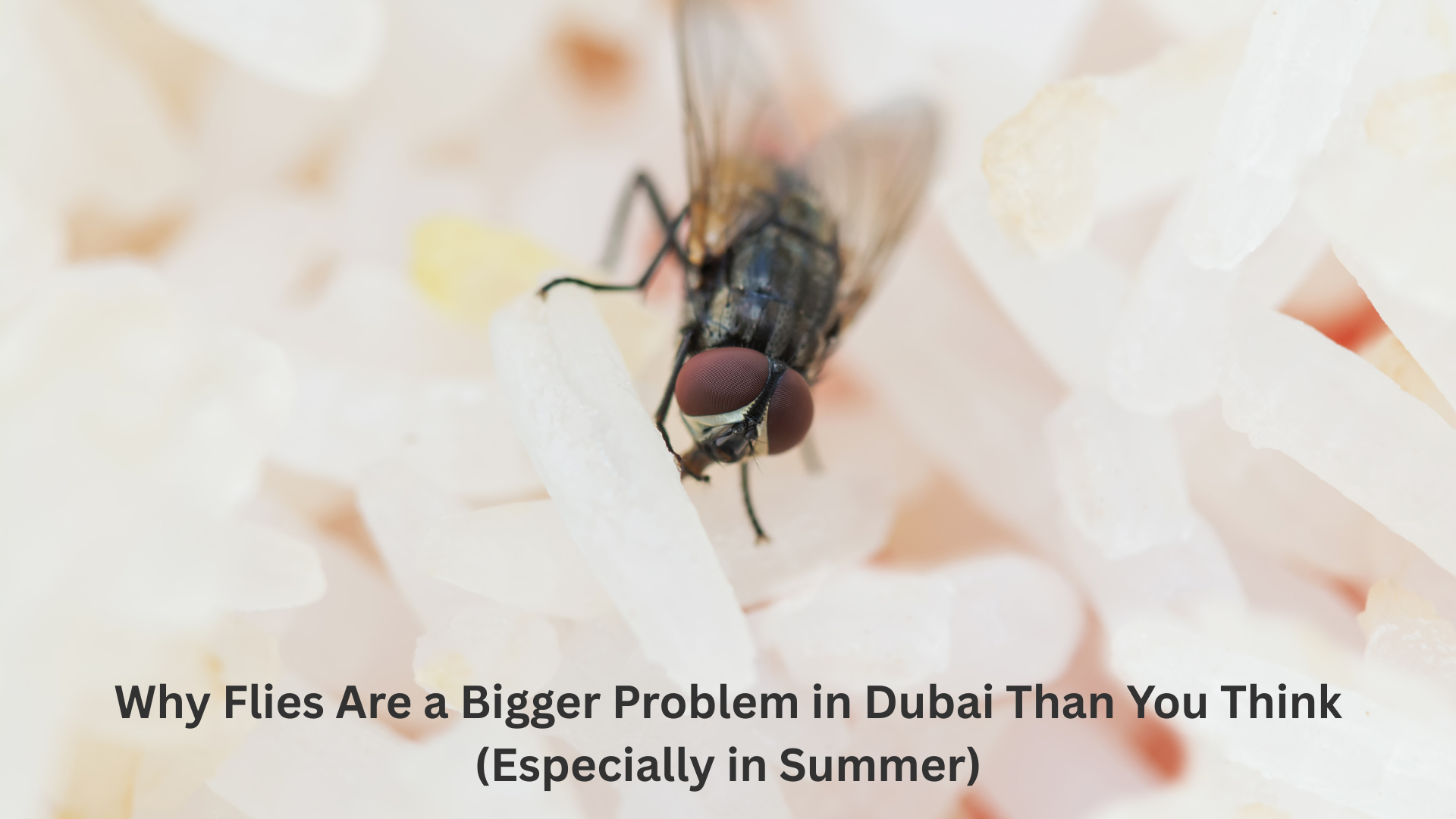
Why Flies Are a Bigger Problem in Dubai Than You Think (Especially in Summer)
Most people in Dubai treat flies as an annoyance rather than a threat. A fly landing on food is brushed off without much thought. A few fruit flies hovering near the kitchen bin are swatted away and forgotten. But the reality of what flies carry, how fast they multiply, and the specific conditions Dubai creates for them every summer paints a very different picture.
Flies are among the most effective disease vectors of any common pest. Every surface a fly lands on — your chopping board, your child’s plate, your restaurant counter — receives a deposit of bacteria picked up from the last surface it landed on, which could have been a drain, a bin, rotting waste, or animal faeces.
In Dubai, fly populations surge dramatically during the summer months as temperatures rise and the city’s specific environmental conditions amplify breeding rates. Understanding why flies are such a serious problem here — and what you can do about it — is essential for every resident, and critical for every food business operating in the city.
Why Dubai’s Summer Creates Ideal Conditions for Flies
Flies are cold-blooded insects — their activity, breeding rate, and lifespan are all directly tied to temperature. Dubai’s summer temperatures, which regularly exceed 40°C outdoors from May through September, create conditions that accelerate fly biology in dramatic ways.
Reproduction Rate Doubles in Summer Heat
A house fly completes its life cycle — from egg to adult — in around 10 days at 35°C. The same cycle takes 30 days at 20°C. Dubai’s summer temperatures mean fly populations can grow three times faster than they would in a temperate climate. A single female house fly lays up to 500 eggs in her lifetime. In peak summer conditions in Dubai, the theoretical descendants of one pair of flies over a single season runs into billions.
Organic Waste Decomposes Faster
Heat dramatically accelerates the decomposition of organic matter — food waste, drain residue, and plant material. Rapidly decomposing organic matter is the primary breeding medium for flies. In Dubai’s summer, a bag of food waste left in a communal bin room for 24 hours provides a far more advanced breeding environment than the same waste would in a cooler climate. The faster waste breaks down, the faster flies can colonise it and breed.
Drain Conditions Worsen in Humid Months
Dubai’s summer humidity — which spikes particularly in July and August — creates ideal conditions inside drainage systems for the organic sludge that drain flies and fruit flies breed in. Commercial kitchens and residential bathrooms with slow-draining sinks frequently see drain fly populations explode during the humid summer months, as warm, moist conditions deep inside drain pipework create a perfect, protected breeding environment.
What Flies Actually Carry — And Why It Matters
The health risk from flies is significantly underestimated by most people. Flies are not simply unpleasant — they are active, highly effective carriers of pathogens that cause serious illness.
A single house fly can carry over 100 different pathogens on its body. It picks these up from every surface it lands on — drains, bins, animal waste, rotting food, and sewage. When it lands on your food or a kitchen surface, it deposits these pathogens immediately.
Flies also feed by regurgitating digestive fluid onto food to liquefy it before consuming it — a process that deposits bacteria directly onto the food surface every single time a fly lands and begins to feed. This happens faster than the eye can track and is invisible to the naked eye.
The diseases flies are known to transmit include:
- Salmonella — a leading cause of food poisoning, causing severe gastrointestinal illness
- E. coli — can cause serious intestinal infection, particularly dangerous for children and elderly
- Typhoid fever — transmitted through contaminated food and water via fly contact
- Cholera — flies are known vectors in areas with open food and waste exposure
- Dysentery — spread through fly contact with food in kitchen and dining environments
- Conjunctivitis (eye infections) — from flies landing near the eyes, particularly in children
Why Flies Are a Particular Risk for Dubai Restaurants and Food Businesses
For residential properties, flies are a serious health concern. For food businesses in Dubai, they represent an existential operational risk.
Dubai Municipality Compliance
Dubai Municipality’s food safety inspections are rigorous and unannounced. Fly activity in a food preparation or service area is treated as a serious food safety violation. Depending on the severity, a fly infestation discovered during an inspection can result in written warnings, financial penalties, required closure for remediation, and in severe cases, suspension of the food licence.
For restaurants operating in Dubai, the reputational damage of a food safety closure is often more severe than the financial penalty — particularly given how quickly news spreads on review platforms like Google, Zomato, and TripAdvisor.
The Summer Peak Problem for Outdoor Dining
Dubai’s outdoor dining season runs during the cooler months — October through April — which coincides with the period when fly populations are lower and more manageable. However, indoor restaurant kitchens face their worst fly challenges during the summer, when heat and humidity drive fly breeding rates to their peak and delivery activity pushes waste volumes higher.
Drain Flies in Commercial Kitchens
One of the most common and persistent fly problems in Dubai restaurant kitchens is drain flies — small, moth-like flies that breed in the organic sludge that accumulates inside floor drains, grease traps, and under equipment. They are particularly difficult to control because they breed deep inside the drain infrastructure, making surface sprays completely ineffective. Specialist larvicide drain treatment is the only reliable solution.
The Four Most Common Fly Species in Dubai — and Why They’re Different Problems
Not all flies are the same problem. Each species breeds in different locations, poses different risks, and requires different treatment approaches.
House Fly
The most common species in Dubai homes and businesses. Breeds in food waste, garbage, and organic matter. Found heavily in kitchens, waste rooms, and around bins. Carries over 100 pathogens. Requires residual spray treatment and UV fly trap installation for effective control.
Fruit Fly
Small flies attracted to overripe fruit, fermenting liquids, and organic drain residue. Extremely common in Dubai restaurant kitchens, bars, and homes during summer. Breeds inside drains and fruit storage — meaning the breeding source is often invisible and requires specialist drain treatment to eliminate.
Drain Fly
Small moth-like flies that breed inside drain pipes where organic sludge accumulates. Common in bathrooms, commercial kitchens, and utility rooms. Surface sprays have almost no effect — the breeding source inside the drain must be treated with larvicide to break the cycle. Drain flies peak in Dubai’s humid summer months.
Blow Fly
Larger metallic flies attracted to meat, fish, and rotting organic matter. Common near outdoor waste bins, food processing areas, and loading docks. In summer, blow flies can complete their full life cycle — egg to adult — in as little as 7–10 days in Dubai’s heat, meaning populations can build extremely rapidly around outdoor waste sources.
Why DIY Fly Control Rarely Works in Dubai
Fly strips, over-the-counter sprays, and plug-in repellents are widely sold in Dubai supermarkets and are widely used. They are also widely ineffective at controlling a genuine fly problem for several specific reasons:
- They only target adult flies — eggs and larvae inside drains, bins, and wall voids are completely unaffected by surface sprays and strips.
- They don’t address the breeding source — killing adult flies without eliminating breeding sites means new adults emerge continuously. The infestation doesn’t shrink, it just cycles.
- Fly strips and sticky traps capture a small fraction of the population in residential settings, and are completely inadequate for commercial kitchens where fly volumes are much higher.
- Consumer-grade insect repellents do not provide the residual protection needed to create a genuine barrier — professional-grade products maintain their effectiveness for weeks after application.
- Incorrect treatment can cause flies to relocate breeding sites deeper into the property — making the problem harder to trace and treat professionally later.
What You Can Do to Reduce Fly Risk This Summer
While professional treatment is the only reliable solution for an established fly infestation, there are practical steps both residents and businesses can take to reduce the conditions that attract and sustain flies:
For Residents
- Empty kitchen bins daily during summer months — food waste in warm indoor environments provides an accelerated breeding source within hours.
- Keep bins sealed at all times — both indoor bins and the building’s communal waste bins. Report overflowing or unsealed communal bins to building management immediately.
- Clean drains weekly with a biological drain cleaner — this breaks down the organic sludge that drain flies and fruit flies breed in before populations establish.
- Store ripe fruit in the fridge during summer rather than on the counter.
- Fix any slow-draining sinks promptly — standing water and organic residue in slow drains is a primary breeding site for fruit flies and drain flies.
- Install fly screens on windows and balcony doors if not already fitted — particularly important for ground-floor and lower-floor apartments.
For Restaurants and Food Businesses
- Install professional UV electric fly killers (EFKs) in all kitchen and food preparation areas — this is best practice under Dubai Municipality food safety guidelines and is considered essential for compliance.
- Schedule professional drain treatment before the summer peak — ideally in April — to eliminate breeding sources inside floor drains and grease traps before fly populations build.
- Ensure waste collection is daily during summer and that waste bins in service areas are sealed.
- Brief kitchen staff on the importance of not leaving food exposed in preparation areas and cleaning up spills and waste immediately.
- Book a pre-summer professional fly inspection to identify any current breeding sources and treat them before the heat causes populations to surge.
For persistent fly problems or commercial kitchens requiring Dubai Municipality compliant fly control, professional treatment from a certified provider is essential. Visit byebug.ae/fly-control/ to learn about ByeBug’s residential and commercial fly treatment options across Dubai.
Fly Problem in Your Dubai Home or Restaurant?
ByeBug provides professional fly control across all Dubai areas for homes and businesses. Dubai Municipality certified treatments including UV fly trap installation, larvicide drain treatment, and residual spray — fully compliant with food safety regulations.
Get a Free Inspection TodayFrequently Asked Questions
Why are there suddenly so many flies in my Dubai kitchen?
A sudden increase in flies — particularly during summer — usually indicates an active breeding source nearby. The most common causes in Dubai kitchens are organic buildup inside drains (drain flies or fruit flies), exposed food waste, or a breeding source in the building’s communal waste area. Identifying and treating the breeding source is essential — killing adult flies without addressing the source means new adults will keep emerging.
Are flies a compliance issue for Dubai restaurants?
Yes. Dubai Municipality food safety inspections treat fly activity in food preparation areas as a serious violation. UV electric fly killers are considered best practice and expected in commercial kitchens. A fly infestation discovered during an inspection can result in penalties or required closure until resolved.
What is the fastest way to get rid of flies in Dubai?
The fastest effective solution is professional treatment — residual spray for adult flies combined with larvicide drain treatment to eliminate breeding sources. For commercial properties, UV fly trap installation provides immediate ongoing capture of adults while breeding sources are addressed. DIY sprays provide short-term relief but do not solve the underlying problem.
How much does fly control cost in Dubai?
Costs depend on property type, fly species, and the treatment methods required. ByeBug offers free inspections and transparent pricing before any work begins. Contact us at byebug.ae/fly-control/ for a no-obligation quote for your home or business.
The Bottom Line
Flies in Dubai are not just a summer nuisance — they are a year-round health risk that peaks severely during the hottest months. The combination of extreme heat, organic waste volumes, drainage conditions, and the density of food businesses across the city creates conditions that make fly control a genuine public health and business compliance issue, not a minor inconvenience.
For residents, the key is eliminating breeding sources — particularly drains and waste — before populations establish. For food businesses, professional UV fly control and pre-summer drain treatment are not optional extras — they are essential components of operating a compliant, safe kitchen in Dubai. If you’re dealing with a fly problem that isn’t responding to DIY measures, or if you want to protect your restaurant before the summer peak, contact ByeBug at byebug.ae/fly-control/ for a free inspection.