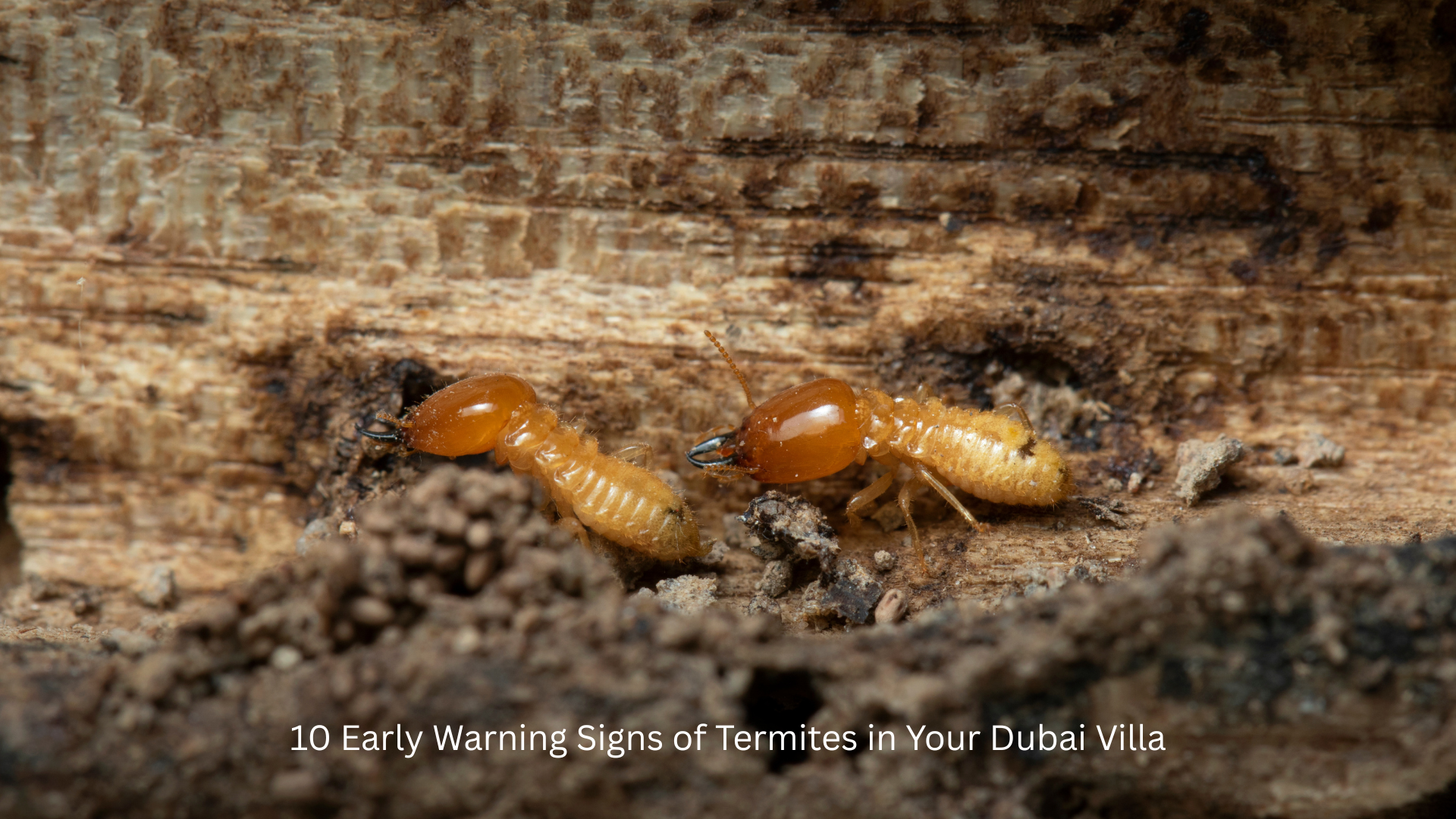
10 Early Warning Signs of Termites in Your Dubai Villa
Termites have earned a well-deserved reputation as silent destroyers. Unlike cockroaches or rats — pests you can see and hear — termites work invisibly inside your walls, under your floors, and through the wooden structures of your home for months or even years before the damage becomes visible.
In Dubai, the risk is particularly high. The city’s warm climate, sandy soil, and high groundwater table in certain areas create near-perfect conditions for subterranean termites — the most destructive species in the world. Villas with gardens in Jumeirah, Mirdif, Al Barsha, and Arabian Ranches are especially vulnerable, as termites travel through soil to reach wooden structures from below.
The financial stakes are serious. Termite damage to a Dubai villa can run into tens of thousands of dirhams in structural repairs — and in most cases, the damage is not covered by standard property insurance. Early detection and professional treatment is the only reliable way to protect your investment.
Here are the 10 warning signs every Dubai villa owner needs to know.
1. Hollow-Sounding Wood When You Knock or Tap
This is one of the most reliable early indicators of termite activity. Tap or knock firmly on wooden door frames, skirting boards, window frames, and structural beams throughout your villa. If the sound is hollow — like tapping on an empty cardboard box rather than solid wood — termites have likely eaten through the interior.
Termites consume wood from the inside out, leaving only a paper-thin outer shell that looks completely normal from the surface. By the time a wooden beam sounds hollow throughout its length, significant structural damage has already occurred.
Where to check: door frames, wooden window frames, skirting boards, staircase banisters, roof timber beams, and any built-in wooden furniture or cabinetry.
2. Mud Tubes Along Your Walls or Foundation
Mud tubes — also called termite tunnels or shelter tubes — are one of the clearest signs of subterranean termite activity. These narrow, pencil-width tubes are built from soil, wood particles, and termite saliva. They serve as protected highways that allow termites to travel from the soil to wooden structures above ground without being exposed to air or predators.
In Dubai villas, mud tubes typically appear along the exterior foundation walls, inside utility rooms, around pipes entering the building, along garage walls, and in garden boundary walls. They are usually brown or grey and blend easily with concrete or plaster — easy to miss unless you’re looking.
If you find a mud tube, break a small section open. Active termites will be visible inside as small, pale, ant-like insects. An empty tube doesn’t mean the infestation is over — termites frequently abandon old tubes and build new ones nearby.
3. Blistering, Bubbling, or Peeling Paint
Paint that is bubbling, blistering, or peeling in areas that are not exposed to moisture is frequently misidentified as a plumbing issue or poor-quality paint. In Dubai villas, it can be a sign of termites feeding and tunnelling just beneath the surface.
As termites consume wood and build moisture-rich mud tubes behind walls, the moisture they create causes the paint surface to lift, blister, and eventually peel. This is particularly common on ground-floor walls, near door frames, and at skirting board level — areas closest to the soil where subterranean termites enter.
If you can rule out water leaks and the blistering is appearing on ground floor walls or wooden surfaces, get a professional termite inspection immediately.
4. Small Piles of Pellets Near Wooden Furniture or Frames
These tiny, oval-shaped pellets are the droppings of drywood termites — a species that lives entirely within the wood it infests and pushes its waste out through small kick-out holes. The droppings are usually tan to dark brown, about 1mm in length, and resemble fine sawdust or coffee grounds at first glance.
You’ll typically find them in small, neat piles on window sills, on floors beneath wooden door frames, on furniture surfaces, and under wooden roof eaves. Unlike the random scatter of sawdust from woodworking, termite pellet piles are consistently placed beneath the kick-out holes in the wood above.
Drywood termites are common in Dubai villas and are frequently found in wooden doors, window frames, roof timbers, and imported wooden furniture.
5. Doors and Windows That Suddenly Stick or Warp
If wooden doors or windows in your villa that previously opened and closed smoothly have suddenly become stiff, difficult to operate, or visibly warped — and there has been no change in humidity or temperature — termite damage may be the cause.
As termites consume the interior of wooden door frames and window frames, they weaken and destabilise the structure. Combined with the moisture termites produce during feeding, the wood begins to warp — causing frames to shift and doors or windows to no longer sit correctly in their openings.
In Dubai’s climate, wooden doors can expand slightly during humid summer months — but if sticking is occurring during cooler months or across multiple doors simultaneously, a professional inspection is warranted.
6. Discarded Wings Near Windows, Doors, or Light Sources
Finding small, translucent wings — often in neat piles near window sills, doorways, or light fittings — is a sign that termite swarmers (reproductives) have entered your villa and shed their wings after finding a location to start a new colony.
In Dubai, termite swarms typically occur in spring and early summer — March through June — when warm, humid evenings trigger reproductive termites to fly out of established colonies to start new ones. They are strongly attracted to light sources and will enter villas through gaps around windows, doors, air conditioning units, and utility penetrations.
Discarded wings are often the first visible sign of a termite problem in villas that are otherwise well-maintained. Do not sweep them up and forget about them — this is an urgent sign that requires professional inspection.
7. Sagging or Uneven Floors
Floors that sag, bounce slightly underfoot, or feel uneven in areas where they were previously firm are a serious warning sign — particularly in villas with wooden sub-floors or wooden structural joists beneath tiled or carpeted surfaces.
Subterranean termites travelling up through the foundation can attack floor joists and sub-floor timbers extensively before any surface sign appears. By the time a floor feels soft or uneven underfoot, the structural timber beneath it may be severely compromised.
This level of damage is expensive to repair and requires complete structural assessment. If you notice floor sagging in any area of your villa — particularly on the ground floor near garden-facing walls — treat it as an emergency.
8. Visible Termite Damage to Wooden Structures
In advanced infestations, the wood itself begins to show visible damage — grooves, channels, and galleries running with the grain of the wood. Damaged wood often has a layered, honeycomb appearance internally and may crumble easily when pressed.
Common locations for visible termite damage in Dubai villas include wooden door frames at ground level, the base of interior wooden columns, wooden skirting boards, staircase treads, roof beams in the attic space, and built-in wooden wardrobes or kitchen cabinets installed against exterior walls.
If visible damage is already present, the infestation is well-established and has likely been active for at least 12–18 months. Immediate professional treatment is essential.
9. Mud or Soil Deposits Inside the Villa
Finding small deposits of soil or mud inside your villa — particularly in corners, along skirting boards, inside wall cavities visible through cracks, or around pipe penetrations — can indicate subterranean termite activity inside the structure.
These deposits are typically part of the termite colony’s mud tube network or nesting material. In Dubai villas, soil deposits inside the property often appear in utility rooms, under staircases, in storage areas, and in any room where the flooring meets an exterior wall — especially on the garden-facing side.
This is different from ordinary dust or soil tracked in from outside — termite mud has a distinctive packed, earthen appearance and is usually found in corners or along structural edges rather than in open floor areas.
10. Your Neighbours Have Had Termite Treatment
This is the warning sign most villa owners overlook entirely — but it is one of the most important. Subterranean termite colonies can extend 50–100 metres underground. If a neighbour’s villa in your compound or on your street has been treated for termites, the same colony that infested their property may already be heading toward yours.
In established Dubai villa communities — particularly in Jumeirah, Mirdif, Al Barsha, and Arabian Ranches — termite infestations in one property frequently trigger discoveries in neighbouring properties within months. Treatment in one villa without addressing the broader colony can simply redirect termites to adjacent structures.
If you know of termite activity anywhere in your community, book a preventative inspection immediately. It is significantly cheaper to install a soil barrier before an infestation than to treat structural damage after one.
Why Dubai Villas Are Particularly at Risk
Several factors make Dubai villas significantly more vulnerable to termite infestation than apartments or newer high-rise buildings:
- Garden access — Subterranean termites travel through soil. Any villa with a garden has direct soil contact with the building foundation, creating easy termite access points.
- Irrigation systems — Garden irrigation keeps the soil moist year-round, which subterranean termites require for survival. Drip irrigation near foundation walls is particularly high-risk.
- Wooden elements — Villas typically contain more wood than apartments — roof timbers, wooden doors, built-in furniture, wooden staircase components, and structural joists.
- Age of property — Many Dubai villas were built in the 1990s and 2000s and have not had termite treatment in many years, if ever.
- Shared soil — In gated communities, villas share unbroken soil with neighbouring properties, allowing a single termite colony to spread across multiple homes.
What to Do If You Spot Any of These Signs
If you’ve identified one or more of these warning signs in your Dubai villa, here’s the right course of action:
- Do not disturb the area — Avoid breaking open mud tubes, removing damaged wood, or applying DIY products before a professional inspection. Disturbing the colony can cause termites to scatter deeper into the structure, making treatment harder.
- Book a professional inspection immediately — A certified termite technician will use specialist detection methods to identify the species, map the extent of the infestation, and assess the structural damage before recommending a treatment plan.
- Don’t delay — Termite damage is cumulative and accelerates over time. A colony that has been active for 12 months will cause significantly more damage in the next 12 months. Early treatment saves money.
- Ask about soil treatment — For subterranean termites, which are the most common species in Dubai villas, a liquid termiticide soil barrier is the most effective treatment. It creates a continuous protective zone around your property’s foundation.
- Consider an annual inspection — Even after successful treatment, annual inspections are recommended for Dubai villas. They catch new activity early and maintain the property’s protection.
Spotted Any of These Signs in Your Villa?
ByeBug offers free termite inspections across Dubai. Our Dubai Municipality certified technicians will assess your villa, identify any active termite activity, and provide a complete treatment plan with transparent pricing — no obligation.
Book a Free InspectionFrequently Asked Questions
How fast do termites cause damage in Dubai?
A mature subterranean termite colony contains 60,000–1,000,000 workers, all feeding continuously. In Dubai’s warm climate where termites are active year-round — unlike cooler countries where activity slows in winter — a large colony can cause significant structural damage within 12–18 months of establishing inside a property.
Does home insurance cover termite damage in Dubai?
In most cases, no. Standard home and building insurance policies in the UAE exclude damage caused by insects and pests, including termites. This makes prevention and early detection critically important — the cost of professional termite treatment is a fraction of the cost of repairing structural damage that insurance won’t cover.
How long does termite treatment last in Dubai?
A professionally applied liquid termiticide soil barrier typically provides 5–10 years of protection when applied correctly around a villa’s full foundation perimeter. Termite baiting systems provide ongoing protection through continuous monitoring and colony elimination. Annual inspections are recommended to maintain protection and catch any new activity early.
Can I treat termites myself in Dubai?
Over-the-counter termite sprays and products available in Dubai hardware stores can kill individual termites on contact but are completely ineffective at eliminating the colony. Subterranean termite colonies live 30–100cm below ground — far beyond the reach of any surface treatment. Professional soil injection and baiting systems are the only methods that reach and eliminate the colony at source.